
“Anybody can do just about anything with himself that he really wants to and makes up his mind to do. We are all capable of greater things than we realize.”

“Throw your heart over the fence and the rest will follow.”

Norman Vincent Peale was a minister and the author of the famous book The Power of Positive Thinking. That book and other works from Peale went on to sell tens of millions of copies. During the depression he, JC Penney and Thomas Watson – of IBM fame – spent time on philantrophy. Peale also had his own radio show for over half a decade.

Here are some of my favourite tips from Peale.

1. Focus on today.

“Don’t take tomorrow to bed with you.”

Focusing on this day today and on tomorrow when it arrives can save you a lot of stress and improve your focus and performance. Of course, you may need to plan for tomorrow. But thinking about it compulsively will just shatter your focus and ensure that you won’t be able to concentrate on what’s in front of you today.

You can – over time – build a habit of spending more time in the present and less time in imagined future scenarios or old memories. You may do this through things like focusing on your breathing or on your inner body.

2. Don’t walk around with the world on your shoulders.

“Drop the idea that you are Atlas carrying the world on your shoulders. The world would go on even without you. Don’t take yourself so seriously.”

I won’t spend much time on this point because I mentioned it just a few days ago and have written about many times before. It’s important though and can really change how you see the world and your life. It makes most things lighter.

3. You may be surprised if you just step up and face your obstacles.

“Stand up to your obstacles and do something about them. You will find that they haven’t half the strength you think they have.”

“The “how” thinker gets problems solved effectively because he wastes no time with futile “ifs” but goes right to work on the creative “how.”

It’s very easy to spend your time thinking and imagining all the horrible things that may happen if you stand up and face your obstacles and troubles in life. But if you actually do that those negative images seldom come into life. They are just huge monsters that you build in your mind. Just like you did when you were a kid and imagined monsters in the closet or under your bed.

When you actually stand up and face your obstacles you may find that the experience isn’t as bad as you imagined. Sometimes it’s actually a bit anti-climatic. You think to yourself: “What?! Is this it?”.

So, after having done some thinking, research and planning on how you can accomplish something just stop thinking. Don’t fall into the trap of overthinking and monster-building. Just go and do what you need to do instead.

4. Understand to overcome.

“Understanding can overcome any situation, however mysterious or insurmountable it may appear to be.”

Talk to people, do some research – in books, online, etc. – and the mist of anxiety and fear often vanishes. A situation may seem scary because it’s not understood and undefined and so your mind projects your worst fears upon that scary looking mist. It can seem like just about anything may jump out of it and attack you. So understanding can be useful. Overthinking, as mentioned in the previous point, not so much.

5. Expect to get what you expect.

“Any fact facing us is not as important as our attitude toward it, for that determines our success or failure. The way you think about a fact may defeat you before you ever do anything about it. You are overcome by the fact because you think you are.”

“Formulate and stamp indelibly on your mind a mental picture of yourself as succeeding. Hold this picture tenaciously. Never permit it to fade. Your mind will seek to develop the picture… Do not build up obstacles in your imagination.”

“Believe it is possible to solve your problem. Tremendous things happen to the believer. So believe the answer will come. It will.”

What you focus your mind on you will see in reality. Your mind can only take in a small part of reality. And the attitude you take towards what you let in lets you see those things through different lenses.

Self-fulfilling prophecies can be very powerful. If you think that you will fail then you’ll find “proof” that you will fail in your reality. If you think you will succeed your focus system in your mind – your Reticular Activation System – will help you find the opportunities for success in your reality. What would remain “in the background” when you focused on the negative will suddenly pop out of the background when you focus on the positive or succeeding.

Now, it may be common or “normal” to focus on the negative (perhaps with a sprinkle of positivity now and again). But it is also all it is. You are free to choose what to focus on all the time. So think about what you focus on because that is what you will see. And what you see is what you will act upon. And your actions do to a large degree determine your results.

6. Find the upsides of the problem.

“Every problem has in it the seeds of its own solution. If you don’t have any problems, you don’t get any seeds.”

“Problems are to the mind what exercise is to the muscles, they toughen and make strong.”

Problems can provide insights and give lessons in how you can grow. So don’t be totally discouraged when running into a problem. Realize that there are usually one or more opportunities in what you perceive as a problem. Doing that regularly makes it easier to not take your problems overly seriously because you aren’t seeing them as totally negative experiences anymore.

So when facing a problem, ask yourself a question like: what’s awesome about this situation? Or ask yourself: what can I learn from this situation?

7. Check your phraseology.

“Watch your manner of speech if you wish to develop a peaceful state of mind. Start each day by affirming peaceful, contented and happy attitudes and your days will tend to be pleasant and successful.”

“Never talk defeat. Use words like hope, belief, faith, victory.”

There is a good amount of power in what words you use. If you use negative words you tend to feel more negative and find more negativity in your world. If you use positive and uplifting words you tend to feel those emotions. This may sound a bit corny or silly, but when you get into the habit of actually using more positively charged words you find that it affects your mood and outlook on things.

8. Don’t go too fast.

“To go fast, row slowly.”

It’s tempting to go fast. But if you go too fast your boat may tip over. You may stumble unnecessarily and make mistakes that you wouldn’t have done if you had just kept a slower pace. Or you may be tempted to grab on to the next big idea, the next “magic pill”, instead of steadily keep going on your current path. To actually get where you want to go a slower pace may be more useful and effective than a hurried and quick pace.

9. Develop the most useful habits of thinking.

“Our happiness depends on the habit of mind we cultivate. So practice happy thinking every day. Cultivate the merry heart, develop the happiness habit, and life will become a continual feast.”

“Repetition of the same thought or physical action develops into a habit which, repeated frequently enough, becomes an automatic reflex.”

What you spend most of your time thinking about you tend to become. One problem may be that you don’t know what you think about most of the time. Just keeping careful notes for a few days can be useful to find out how you spend your time and thoughts.

To install more of a positive attitude or positive thinking into your mind you need to have patience. It may not be easy and you’ll probably fall back into old thought patterns a lot of the time. But I have discovered that over time – we’re talking about months here – you can slowly spend more and more of your week with, for instance, positive thoughts rather then negative ones. And after a while positive thoughts tend to become more and more automatic. Just like when playing tennis you don’t have to think so much about striking the ball after a while. It becomes an automatic reflex.

One helpful tip while installing new thought habits is to continually remind yourself about them by asking yourself questions that keeps you steadily on this new mental track. Or gets you back on track if you veer off it. You can use notes posted on your computer, fridge, and bathroom mirror to remind yourself to actually ask yourself the questions.

10. Learn not only from your mistakes.

“We’ve all heard that we have to learn from our mistakes, but I think it’s more important to learn from successes. If you learn only from your mistakes, you are inclined to learn only errors.”

“Check what you did right and don’t get lost in basking on your glory. It will make it easier to repeat whatever you did that created the success.”

I thought this was an interesting reminder. Our mistakes are interesting because they can often teach us something valuable if we just take a closer look at what happened. But, of course, the successes are really useful to analyze too.

It is here we can find perhaps a crucial detail or something that we did that we missed the other 10 times we tried. So, as Peale says, don’t get totally lost in basking in your glory. Or make the mistake of seeing your success as just having a bit of luck for once. Take a close look at what happened and what you did right. Preferably sooner than later as memories can quickly become a quite fuzzy. And write down what you come up with to prevent that the conclusions become fuzzy.
How to Keep Yourself on Track: 5 Helpful Questions

“Reason can answer questions, but imagination has to ask them.”
Dr. Ralph Gerard

“The one who asks questions doesn’t lose his way”
African Proverb

One of the most basic but difficult things when trying to grow is simply to keep yourself on the right track.

To not veer off in your mind and in your world and take a wrong turn. This is unfortunately easily done in the day to day life as your ambitions and dreams may be forgotten among all your responsibilities and old habits.

One thing that’s been useful for me is to continually ask myself helpful questions in various situations throughout my week. By asking yourself helpful questions you’ll get helpful answers. By, on the other hand, asking yourself disempowering and negative questions you’ll stop yourself from helping yourself. You tend to get what you ask for.

Here are five of my favourite questions right now.

Adding those – or your own favourites – to external reminders such as a bracelet or notes posted in highly visible places can be very useful when your mind is heading down a slippery slope of negativity or pointless babbling.

Also, as you start to use the questions more and more they tend to start to pop up almost automatically at useful points in your everyday life. The second question in this article is for instance one that my mind often asks me pretty much automatically nowadays whenever I find myself up in a negative situation.

1. Is this useful?

This is a good way to weed out thought habits that may not be so useful. Your mind may for instance fool you into believing that it’s the right thing to go around being angry at someone because, well, you’re right. Or that it’s right to dwell on a problem because you had such bad luck or was singled out.

Both thought patterns are quite seductive because they can fool you into believing that you are doing the “right” or “normal” thing. But are such thoughts useful to you? Probably not. They’ll just create suffering in your life, waste your time and do little to solve a practical situation. By asking if something is useful you can stop yourself while heading down a negative path and turn around towards the light again.

2. What is awesome about this situation?

This is a good way to find the lesson within an experience that may be seen as negative. Or to just reframe a situation and create some positivity and enthusiasm within yourself to get going to practically handle a situation instead of falling back into a dwelling, negative victim-thinking kind of thought pattern.

Asking yourself this question may seem stupid or silly at first. You may not find anything positive or awesome about a situation at all. But after you’ve started to ask yourself the question in more and more situations you’ll probably find something that’s at least good about the situation.

And the more awesome, positive and good things you can find in experiences the more your mind starts to accept that you can indeed find something good in just about any situation. Your mind just has to get a bit used to thinking about things in this new and unfamiliar way.

3. How can I give value in this situation?

This is a good way to improve your relationships and interactions. I listed four awesome reasons to give value in your everyday life two weeks ago. They are:

  • It makes you feel awesome.
  • You tend to get what you give.
  • It makes your life a whole lot more fun.
  • It makes it easier to start new relationships.

What value can you give in a situation/to another person? Well, a few suggestions would be: bringing a positive attitude into situations, lending a listening ear, cheering someone up, offering useful advice or creating a fun/exciting situation for people in your life.

By asking yourself this question you can add more value to other people’s lives. And more value and joy to your own life.

4. Am I taking this too seriously?

This is wonderful question to ask yourself to lower stress levels and be able to feel better and perform better in a situation where you have created a lot of internal pressure upon yourself. It take much of the self-imposed seriousness and weight off on your shoulders. It makes life lighter.

This is one question that I have some difficulty remembering from time to time, but when I do – which I usually do at some point – then it makes me feel a whole lot better. You can read more about not taking life too seriously and find some practical tips for doing that in Lighten Up!

5. Will this matter 5 years from now?

This is pretty similar to the previous question but I wanted to include it anyway. Why? Because it can really puts things into perspective. It can make just about any difficulty that you are having right now seem a bit trivial and not as important and heavy as you had imagined the last few days, weeks and months. You may discover that you had expanded and made the problem a lot more terrifying than it actually is.

Asking yourself a combination of the previous question plus this question may help you to put just about anything in your life into a more healthy and relaxed perspective.

Now, what is your favourite/best question to ask yourself?

Oprah’s Top 7 Tips for Creating the Life You Want

“If you want your life to be more rewarding, you have to change the way you think.”

“For everyone of us that succeeds, it’s because there’s somebody there to show you the way out.”

One of the coolest things online this spring was the webinars with Oprah and Eckhart Tolle. Each week during 10 weeks they discussed the ego, the present, consciousness and other ideas from Tolle’s book A New Earth. 

Today I’d like to focus a bit on Oprah. So here are a few of her tips and reminders that resonate with me right now.

1. Keep your focus in the right place.

“Be thankful for what you have; you’ll end up having more. If you concentrate on what you don’t have, you will never, ever have enough.”

This is a pretty clever tip that can have a larger influence on your life than you may imagine. Within your mind there is something called Reticular Activation System (or RAS). It can help you because what you focus your thoughts on this system will start to try to find evidence of in your surroundings.

Since you can only take in a small part of all impressions what you focus on becomes very important.

In fact, changing what you focus on can seem to change your world radically.

When you focus on what you have and appreciate it or focus on what you want a lot of things will start to “pop up” in your reality. It was actually there all along.

But you can only see it when you shift your focus. If you focus on what you don’t have your RAS will only help you to find evidence of that.

By being thankful and making appreciating a regular habit you cannot only quickly change a sour mood into a positive one. You can also have more of what you want and kinda automatically find solutions and useful information that can help you to achieve what you are focused on. An external reminder or two – for instance post-it notes on your fridge – can be helpful to keep your focus in the right place in your day to day life.

2. Redefine failure.

“I do not believe in failure. It is not failure if you enjoyed the process.”

“Do the one thing you think you cannot do. Fail at it. Try again. Do better the second time. The only people who never tumble are those who never mount the high wire. This is your moment. Own it.”

“I believe that one of life’s greatest risks is never daring to risk.”

One of the big things holding people back from getting what they want is the fear of failure. But as written many times before, failure can be a very helpful learning experience. In fact, without failure you’ll probably never learn the things you need to achieve the success you dream of. So, instead of seeing failure as something big and scary, redefine it in your mind as a learning experience. Two more tips for dealing with failure in a useful way are:

  • Create an abundance mentality. A scarcity mentality tells you that there is always a lack. An abundance mentality tells you that there is always an abundance. That there are always more goals that you can score, business opportunities to find and dates to be had. If you miss one, then learn what you can from it. But don’t let it drag you down. Use the first tip in this article and bring your focus back to what you want once again. Focus on the abundance. This will not only make it easier to take a chance on something but is also a good thing to focus on to reduce those negative feelings, those fears of failure that to a large degree is created within your mind because of a perceived lack.
  • Focus on the process. What this means is that you just focus on what you are doing. You don’t think about the possible outcomes of what you are doing when you are doing what you do. You detach from that. You just keep your mind focused on doing the work. You don’t think about how you may fail, disappoint yourself or have great success. You don’t think about how you may disappoint, amuse or in some other way be seen through the eyes of others. You just focus on what you do. And so what you do becomes enjoyable even though it may contain some stumbling or failures. You can read more about focusing on the process and detaching from the outcome in The Relaxifying Secret to Success.

3. You are fueling your own fear.

“Whatever you fear most has no power – it is your fear that has the power.”

Fear is mostly just a loop of thoughts that you are feeding with new energy. When you accept what is and face your fear then you stop feeding it and it dissipates.

So the key is to accept. Accepting what is stops the flow of energy back into the fear. One way to do this is by surrendering to the emotion. And then to take the action that you fear. By surrendering you remove or at least weaken the negative emotion that is holding you back. By taking the action your mind gets the proof that whatever you feared wasn’t really that scary.

Here’s one way to surrender to your emotion:

When you feel a negative feeling then accept that feeling. Don’t try to fight it or to keep it out (like many of us have learned throughout life). Say yes to it.

Surrender and let it in. Observe the feeling in your mind and body without labeling or judging it. If you let it in – for me the feeling then often seems to physically locate itself to the middle of my chest – and just observe it for maybe a minute or two something wonderful happens. The feeling just weakens and sometimes vanishes completely.

4. Do the right thing.

“Real integrity is doing the right thing, knowing that nobody’s going to know whether you did it or not.”

This is a real interesting one. But how do you do it? How do you keep doing the right thing when nobody’s looking and checking up on you? I certainly don’t have a complete answer for that but two useful things I’ve found are these:

  • Make your own rules. It seems to me that if you are to stick to doing the right thing then you need to take your eyes from the rules and values set by people around you. You need to define yourself and what you’re about. If you play by other people’s rules then you’ll be answering to those people. And it will be pretty easy to slip up or cheat when no-one is watching. But if you make your own rules then you answer to yourself. When you are accountable to yourself instead of the world around you it will be easier to do what you feel is right more consistently.
  • Get off dependence on external validation. If you are dependent on external validation – people telling you that you are doing a good job etc. – then it will be hard to play by your own rules. You’ll constantly be looking outward to see how you are doing and adapt to what people are telling you. And if you’re hooked on such validation then it will be tempting to just cheat or skip doing the right thing when nobody is watching, because there is no-one there to praise you anyway. You can read more about external validation – and about replacing it with internal validation – in 9 Great Ways to Make Yourself Absolutely Miserable.

5. You get what you give. In more than one way.

“What I know for sure is that what you give comes back to you.”

This is of course a classic piece of advice. And I believe it’s pretty accurate. People tend to adapt and reciprocate. They treat you as you treat them. But lately I’ve also been thinking about how this seems to work in another way.

It seems to me that what you do to others you also directly do to yourself. If you pour out a lot of negativity out into the world then you also pour that energy into yourself. For the moment, it may feel good to gossip about your boss. But I believe that much of the negativity that you find in your life is caused by this behavior. It may not be directly tied to what you said or did. But it seems to me like you cannot hurt someone without, in some way, hurting yourself too.

The more negativity you dole out the worse you tend to feel in your everyday life. The more problems you find and cause. The more you overreact and feel a sad funk arising from nowhere in particular. Maybe it’s because giving out much negativity causes you to focus your RAS more on the negative things in your life.

6. Let go of the past. Live in the present.

“Breathe. Let go. And remind yourself that this very moment is the only one you know you have for sure.”

One of the best things you can do to improve your life and feeling of well-being is to let go of what has happened. To not be dwelling on whatever negative things that happened in the past for too long. But how do actually you do it?

I have found a few good tips so far. They work well, and will probably work even better as time passes and I get better at using them.

The first one is to ask yourself throughout the day or when you feel like you’re spiraling down into negative thoughts: what’s in it for me? What is in for me by thinking about these thoughts?

I often realize that there is very little in it for me. Negative thoughts or replaying a negative memory over and over in my mind isn’t helping that much. Sure, you can derive a sort of pleasure – a sort of importance – by feeling like a victim or by hating someone and secretly plotting for some kind of revenge. But really what you are doing is wasting your time and energy.

That’s what’s in it for you. For instance, someone who is hated might not feel good about it. Or s/he may on the other hand not even notice it. It is always the hater that suffers the worst, that carries around the self-imposed curse. S/he spends hours, days or months in a cloud of negative thoughts that spill over into the rest of his/her life too.

You have already read about the second tip: focus on what you want. And focus on the abundance instead of the scarcity.

The third tip is to learning to spend more and more time in the present rather than the past or a projected future. And the best practical way I have found so far to do that is ties back to the beginning of this article. Pick up a copy of Eckhart Tolle’s A New Earth and if you like, start watching/listening to the webinars.

7. It’s up to you what happens.

“We are each responsible for our own life – no other person is or even can be.”

When we are young other people are responsible for our lives. I think that one sign of a mature person would be that he or she takes 100% responsibility for his/her own life. Still, there is often a lingering feeling that we may want someone else to still be responsible for our lives.

One way that this manifests is in how people go looking for magic pills. Instead of buckling down, taking responsibility for their own life and working step by step towards a goal there is a need for a book, a program, a pill or something we can buy that will make our problem go away. Like how mom or dad used to fix your problems and make them go away.

Now I’m not saying that I haven’t been looking for magic pills. Maybe everyone needs to go through such phases. But I think that when you can let go of such searching then you are probably on a road that will bring you better results than your search for magic pills did.

Why? Well, you realize that you need to be behind the wheel and in control. And when you stop spending time looking for the next magic pill you become focused. You realize that no book can give you more than the knowledge. You realize that you need to take action in your life and create your life in the way you want it.

And now all those books you bought may become more useful. Because you are no longer looking at them as a magic pills that will “fix you”. You see them as road maps that can guide you along your path.

Note: This is guest post by Mike King of Learn This.

Stress is a common complaint from people about why they don’t lead a happier life, a more positive life. And since worry is one of those factors that leads to stress, I want to explore in detail what worrying causes, the things we can learn from worry and some steps to take that let us change the way we experience worry.

Worrying Stems from Fear

It’s simple definition, worry is the act of thinking about the unknown in a way that we fear. Regardless of what the situation, if you think about that event in a way that makes you fear the outcome, that thought will stay with you, generate more similar thoughts and create constant worry.

If you hold onto these thoughts, they can quickly become overestimated and exaggerated to the point that what started out as a simple concern, becomes a painful fear. The fear itself can cascade itself by generating worse and worse thoughts that just reinforce the worry and stress associated with it.

Now, its quite natural to have fears about the unknown. There is nothing wrong with fear, in fact, it has a lot of advantages which I’ll outline below. What’s dangerous about these fears though is if you allow yourself to focus on only the results you fear, even when there is no basis or reason to believe that that is the likely outcome.

This is the kind of fear and worry that gets you nowhere! Ignoring every other possible outcome (and generally the most likely and often positive outcomes) to think constantly about the one outcome we fear is a major cause of stress. This often is the worst outcome or the thing we fear the most. The problems this can cause are:

  • Detracts your focus on useful activities.
  • Worry from fear is hard to forget or unlearn, so it re-occurs easily and becomes habitual.
  • Affects your other activities in a negative way (often pessimistically).

Advantages of Worry

There are some advantages you can have from worry as well:

  • Worry can guide you to recognize what is meaningful if you don’t know already.
  • Helps you to predict possible bad outcomes before they happen so you can avoid them.
  • You can demonstrate care and love to others by showing signs of worry when its about their welfare.

Recognizing Worry

One of the first steps to learning to handle worries in a more positive way is to first recognize when you are in fact worrying. These are common visible traits of a person who is worrying.

  • Irritability.
  • Confusion.
  • Nightmares.
  • Insecurity.

Each of these traits and potentially many more are signs of a person under stress caused by worry. When you can learn to recognize these in your own behaviors, you should stop and take note as to WHY you are feeling and behaving that way, its quite possibly due to worry.

Unfortunately, since most worriers don’t even realize they worry as much as they do, some extra steps can make it even easier to recognize. Get a notepad and pick a couple of times that you can write down your thoughts every day (perhaps at meals or at certain times each day).

Do this for about a week or two, noting what were your main thoughts (and likely worries) at that time. What kinds of things were you doing? Who were you spending your time / thoughts on? Noting these things will help to show some simple patterns and identify a few main areas that seem worrisome and consume a lot of thoughts. It’s not until you recognize what you actually do worry about, that you’ll be able to change it.

These can be anything from worries about major areas in your life like your safety and security, welfare of others, loss of relationship control, self-control of circumstances, approvals and decisions that you rely on others for, money and finances, your faith or spirituality, your health and wellness all the way down to simpler worries like finding time to do what you want, getting your tasks completed, talking to strangers in public, driving somewhere, etc.

5 Ways to Control and Limit Your Worry

So, with some of your specific worries identified, its time to look at ways to change those worries and turn them around from being such a negative force.

The way to do this is to eliminate or at least for now, hide or minimize the negative thoughts and focus more on the positive outcomes with all the things that you normally find yourself worrying about. Some steps to do that are listed below. Combining several, all or just some of these with other techniques can make great progress to controlling and limiting your worry.

Write down all the positive outcomes and your most favorable one

Pick one of the items you regularly worry about and focus on it. Write down all the positive outcomes you have in relation to that activity and also write down your most favorable one, even if it doesn’t or is unlikely to ever happen. These positive outcomes are a reminder to all the good things that occur for that event and the most favorable one is a bit of carrot or a hope that it can be even better than you normally experience. This is important, as it can help to outbalance the negatives you are used to thinking.

Make your list as long as possible, try to get 10-20 positives for anything you normally find yourself stuck worrying about. Keep your list on hand and when you find yourself thinking about this event, read through your list. Reread it and even memorize it if it helps to keep attention to it. This process will slowly start to train your mind to look for different kinds of outcomes, the positive ones instead of the worst. This will reduce your worrying.

Appreciate the good things from the day

Before you go to bed, take just a couple of minutes and think of 3-5 good things that happened to you that day and be appreciative of them. Maybe someone was extra nice or gave you a compliment, perhaps you got something done quickly or particularly well, or maybe just seeing a few new positives in some event was a highlight of your day, whatever it was, say it out loud or to yourself, or pray about it, whatever you want to do, just show some appreciation for those good events. This is again a step in learning to see more positives around you.

Don’t think about the next day when going to bed, just memories of that day

One thing I’ve read that traps a lot of worriers is that they think about or plan their next day before they go to bed. I can’t urge against this strongly enough. You don’t want to go to bed with your mind focused on foreseen problems of the next day. Especially in the mind of a worrier, since it will distract your sleep, your dreams and just reinforce itself through the night in habitual negative ways. You are much better off keeping your last thoughts before sleeping positive and NOT worrying about the next day when you go to sleep.

Use affirmations about that outcome already having occurred

Changing your mindset is not an easy task (I’ve written about mastering your state of mind here), and changing your beliefs that guide your reasons for worry fits into that mindset deeply. Changing that requires a number of tools and while affirmations may not work for everybody, they are a proven powerful tool which can definitely help you to change your thinking about the outcomes you worry about.

Basically, you affirm (or state in a present sense) how you feel about being and experiencing the positive outcomes you desire with complete disregard to previous negative worries you’ve had in the past. Its best to do these affirmations out loud, and repeatedly.

An example of someone who has previously been worried about driving in the city might sound like: I feel so independent and free to drive myself safely anywhere I like in the city.

Remind yourself of all the previous times the best action has occurred

Most worriers do so with little reason. If you count up all the outcomes and results of many events that a worrier stresses over, it’s easy to see that this worrying is usually unjustified. Looking at all the time the event just worked out and there was no reason to worry in the first place helps to re-enforce good outcomes. Use those numbers and histories to remind yourself that the most likely outcome is actually the desired outcome and any bad is VERY unlikely to occur so shouldn’t be worried about.

Avoiding Worry

So, even once you’ve learned to control and limit your worry, this can be taken even further by avoiding the process of worrying all together. I’m no expert here but I have found and read about several things that can help to free your mind of worry.

  • Avoid the source or situation that generates the worry in the first place (after all, its not that easy to eliminate the fear behind a worry)
  • Encourage new outcomes and be excited for new experiences. The fear of change usually turns this into worrying about the unknown so developing a sense of adventure for new experiences and outcomes will embrace them without needing to worry about them.
  • Keep your results and records and remind yourself of how often things really do go as expected for you and that you have nothing to worry about!
  • Don’t reinforce others to worry (make good outcomes welcome, encourage them)
  • Whatever happens happens. You probably had no control over it anyway, so just let it go.
  • Learn to just be, instead of wanting to control. This takes practice and faith, whether that is in you, others around you or something spiritual, faith is really the opposite of worry.

So, what can you really gain from worrying? Is there anything you can do about it anyway? What can you do next time to avoid worrying about it again?

Ask yourself some of these questions next time you find yourself worrying. Use some of these techniques to kill that unnecessary worry time in your life and live a more positive and carefree life!

Mike is the author of Learn This, a productivity blog for self learning career, leadership and life improvement tips. He’s written many articles about finding your passion in life, goal setting and many other ideas around learning to have a better and more positive life. Please subscribe to his RSS feed here to read more of his articles!

4 Awesome Reasons to Give Value in Your Everyday Life

“Wealth, like happiness, is never attained when sought after directly. It comes as a by-product of providing a useful service.”
Henry Ford

“This communicating of a man’s self to his friend works two contrary effects; for it redoubleth joy, and cutteth griefs in half.”
Francis Bacon

“Treat people as if they were what they ought to be and you help them to become what they are capable of being.”
Goethe

How do you become a successful blogger?

The first answer that super-successful people like Steve Pavlina, Darren Rowse or Leo Babauta may offer you is probably to create and give value. If you give some kind of useful value to people then they are open and interested in reading your blog and recommending it to their friends.

You may give them practical tips for improving your life like this blog does. Or review the latest video-games for the gamer crowd. Or provide the latest scoops about Britney for people interested in gossip about celebrities.

Now, you may not be a blogger. But bloggers are basically just people in interactions or conversations with other people. Just like you are with your friends, family, co-workers, school mates or whoever you are hanging out and interacting with.

In blogging giving value may be one of the three things I suggested above. In your daily life it may be things like:

  • Bringing a positive attitude and vibe into interactions.
  • Offering useful advice or knowledge to someone.
  • Just offering a listening ear to someone who needs it.
  • Cheering someone up.
  • Hugs.
  • Helping someone out with moving, cooking, cleaning up etc.
  • Taking the lead and creating a fun situation for your friends such as a picnic or a night out on the town.
  • Being totally present in conversation and focused on the other person. This is a quality that I believe is often mentioned about networkers that are great at creating new relationships like Bill Clinton.

Now, why should you go to all that trouble and effort? It’s easier to just get people to do those things for you instead. Well, here are four reasons.

1. It makes you feel awesome.

It’s funny, for quite a long time I thought that the way to feel better was to get people to give me things. To give me some kind of value.

And that makes you feel good. For a short while. Then your emotions kinda snaps the other way like a rubber band. And, once again, you don’t feel so good.

Why? Well, you are taking these things and adding them to yourself. But the ego always wants more. The positive feelings you get from whatever you are given wears off pretty quickly. And so you want people to give you more value again. It’s like when you buy a new shirt or pair of shoes. You feel great about them for a while but after that they lose their magic. They become “normal”. And so you go the store again.

Now, giving value is to a better way to feel good. You control how much value you want to give and how you feel. It’s a more consistent way to feel good. To me it’s almost always more powerful than the quick hits of positive emotions you get from getting value.

But it’s a bit counter-intuitive. When you’re feeling down, it seems pretty natural to need a compliment to feel better instead of giving someone a compliment. So I have an external reminder in the form of a post-it note on my desk that says: “Feeling bad? Give value.”

2. You tend to get what you give.

People often have a strong feeling of wanting to give what they got. Perhaps not right away, but over time reciprocity and a positive relationship can build. And in general, what you give you tend to get back from the world around you.

I try to avoid keeping this in the forefront of my mind while giving value though.

It’s a good idea to do so because if you don’t then it may make whatever you doing seem insincere. Like you are just out to get something from the other person. And if you are just doing things for people to get them to do things for you then you may not feel so good about yourself and become a bit negative, irritated or needy.

Some people won’t reciprocate. They may be totally stuck in a sucking value kind of mode. And well, in time you may naturally feel inclined to give more value to and hang out with people that reciprocate and offer value to you.

3. It makes your life a whole lot more fun.

By giving value in a genuine way you tend to take more action than if you are waiting for someone to give you value. And by taking more action and giving more value you tend to – over time – create more interesting and fun situations. Because more action leads to more things happening and more value given leads to more reciprocation from other people.

And since you feel awesome from giving value that emotion is of course contagious. So you and the people around feel better and tend to get into a more positive and open mood and frame of mind.

4. It makes it easier to start new relationships.

Much of this post is about improving your relationships with people. But it’s also a good way to start a relationship.

If you read any blogs about blogging then you may have read that a not so useful way to email a blogger and create a relationship with that person is to just ask him/her to do something for you. I agree with that.

If someone sends me an email where s/he offers value – perhaps give me a compliment, constructive criticism, offers to help if I would need it in the future – I tend to feel grateful and think that this person who emailed me is a cool and sympathetic person. If I, on the other hand, get an email where someone just wants me to do this or that then that’s often a bit of a turn-off. I think this is true in off-line interactions too.

Now, how can you bring more value into the lives of the people around you? Think about it from time to time. And take action on your ideas.

And remember what Seneca said.

“It is another’s fault if he be ungrateful, but it is mine if I do not give. To find one thankful man, I will oblige a great many that are not so.”

Even though people may not appreciate the value you give you can still feel good about yourself. Their reaction and response is their business. Not a always an easy lesson to incorporate into your own life. But a useful one to keep your mood and belief in yourself from going on an emotional roller coaster controlled by other people’s responses to what you do.

Like so many other thought habits, this one can take time to change. Over time you can become more and more of person that gives value instead of doing the opposite. And if you are anything like me then you’ll slip many times and fall back into the value sucking mode. And that is one reason why I wrote this article. To remind myself of how I can quickly turn a negative mood around and overall make my life a more positive place to be.

And more of your time each week with people who are trying to improve themselves and/or are living a good life in a positive, healthy and relaxed way.

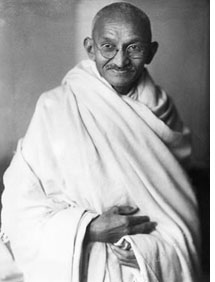
Gandhi's Top 10 Fundamentals for Changing the World“You must not lose faith in humanity. Humanity is an ocean; if a few drops of the ocean are dirty, the ocean does not become dirty.”

“The difference between what we do and what we are capable of doing would suffice to solve most of the world’s problem.”

“If I had no sense of humor, I would long ago have committed suicide.”

Mahatma Gandhi needs no long introduction. Everyone knows about the man who lead the Indian people to independence from British rule in 1947.

So let’s just move on to some of my favorite tips from Mahatma Gandhi.

1. Change yourself.

“You must be the change you want to see in the world.”

“As human beings, our greatness lies not so much in being able to remake the world – that is the myth of the atomic age – as in being able to remake ourselves.”

If you change yourself you will change your world.

If you change how you think then you will change how you feel and what actions you take. And so the world around you will change.

Not only because you are now viewing your environment through new lenses of thoughts and emotions but also because the change within can allow you to take action in ways you wouldn’t have – or maybe even have thought about – while stuck in your old thought patterns.

And the problem with changing your outer world without changing yourself is that you will still be you when you reach that change you have strived for.

You will still have your flaws, anger, laziness, negativity, self-sabotaging tendencies etc. intact.

And so in this new situation you will still not find what you hoped for since your mind is still seeping with that negative stuff.

And if you get more without having some insight into and distance from your ego it may grow more powerful. Since your ego loves to divide things, to find enemies and to create separation it may start to try to create even more problems and conflicts in your life and world.

2. You are in control.

“Nobody can hurt me without my permission.”

What you feel and how you react to something is always up to you. There may be a “normal” or a common way to react to different things. But that’s mostly just all it is.

You can choose your own thoughts, reactions and emotions to pretty much everything.

You don’t have to overthink, freak out, worry of even react in a negative way. Perhaps not every time or instantly.

Sometimes a knee-jerk reaction just goes off. Or an old thought habit kicks in.

And as you realize that no-one outside of yourself can actually control how you feel you can start to incorporate this thinking into your daily life and develop it as a thought habit.

A habit that you can grow stronger and stronger over time. Doing this makes life a whole lot easier and more pleasurable.

3. Forgive and let it go.

“The weak can never forgive. Forgiveness is the attribute of the strong.”

“An eye for eye only ends up making the whole world blind.”

Fighting evil with evil won’t help anyone. And as said in the previous tip, you always choose how to react to something.

When you can incorporate such a thought habit more and more into your life then you can react in a way that is more useful to you and others.

You realize that forgiving and letting go of the past will do you and the people in your world a great service.

And spending your time in some negative memory won’t help you after you have learned the lessons you can learn from that experience.

You’ll probably just cause yourself more suffering and paralyze yourself from taking action in this present moment.

If you don’t forgive then you let the past and another person to control how you feel. By forgiving you release yourself from those bonds. And then you can focus totally on, for instance, the next point.

4. Without action you aren’t going anywhere.

“An ounce of practice is worth more than tons of preaching.”

Without taking action very little will be done. However, taking action can be hard and difficult. There can be much inner resistance.

And so you may resort to preaching, as Gandhi says. Or reading and studying endlessly. And feeling like you are moving forward.

But getting little or no practical results in real life.

So, to really get where you want to go and to really understand yourself and your world you need to practice. Books can mostly just bring you knowledge.

You have to take action and translate that knowledge into results and understanding.

Move on to the next point for more on the best tip for taking more action that I have found so far.

5. Take care of this moment.

“I do not want to foresee the future. I am concerned with taking care of the present. God has given me no control over the moment following.”

The best way that I have found to overcome the inner resistance that often stops us from taking action is to stay in the present as much as possible and to be accepting.

Why?

Well, when you are in the present moment you don’t worry about the next moment that you can’t control anyway. And the resistance to action that comes from you imagining negative future consequences – or reflecting on past failures – of your actions loses its power.

And so it becomes easier to both take action and to keep your focus on this moment and perform better.

Have a look at 8 Ways to Return to the Present Moment for tips on how quickly step into the now. And remember that reconnecting with and staying in the now is a mental habit – a sort of muscle – that you grow.

Over time it becomes more powerful and makes it easier to slip into the present moment.

6. Everyone is human.

“I claim to be a simple individual liable to err like any other fellow mortal. I own, however, that I have humility enough to confess my errors and to retrace my steps.”

“It is unwise to be too sure of one’s own wisdom. It is healthy to be reminded that the strongest might weaken and the wisest might err.”

When you start to make myths out of people – even though they may have produced extraordinary results – you run the risk of becoming disconnected from them.

You can start to feel self-doubt and like you could never achieve similar things that they did because they are so very different.

So it’s important to keep in mind that everyone is just a human being no matter who they are.

And I think it’s important to remember that we are all human and prone to make mistakes. Holding people to unreasonable standards will only create more unnecessary conflicts in your world and negativity within you.

It’s also important to remember this to avoid falling into the pretty useless habit of beating yourself up over mistakes that you have made.

And instead be able to see with clarity where you went wrong and what you can learn from your mistake. And then try again.

7. Persist.

“First they ignore you, then they laugh at you, then they fight you, then you win.”

Be persistent. In time the opposition around you will fade and fall away.

And your inner resistance and self-sabotaging tendencies that want to hold you back and keep you like you have always been will grow weaker.

Find what you really like to do. Then it will be easier to stay positive and you’ll find the inner motivation to keep going, going and going.

You can also find a lot of useful tips on how keep your motivation up in 32 Simple Ways to Motivate Yourself.

One reason Gandhi was so successful with his method of non-violence was because he and his followers were so persistent. They just didn’t give up.

Success or victory will seldom come as quickly as you would have liked it to. I think one of the reasons people don’t get what they want is simply because they give up too soon.

The time they think an achievement will require isn’t the same amount of time it usually takes to achieve that goal.

This faulty belief partly comes from the world we live in. A world full of magic pill solutions where advertising continually promises us that we can lose a lot of weight or earn a ton of money in just 30 days.

Finally, one useful tip to keep your persistence going is to listen to Gandhi’s third quote in this article and keep a sense of humor. It can lighten things up at the toughest of times.

8. See the good in people and help them.

“I look only to the good qualities of men. Not being faultless myself, I won’t presume to probe into the faults of others.”

“Man becomes great exactly in the degree in which he works for the welfare of his fellow-men.”

“I suppose leadership at one time meant muscles; but today it means getting along with people.”

There is pretty much always something good in people. And things that may not be so good. But you can choose what things to focus on.

And if you want improvement then focusing on the good in people is a useful choice. It also makes life easier for you as your world and relationships become more pleasant and positive.

And when you see the good in people it becomes easier to motivate yourself to be of service to them. By being of service to other people, by giving them value you not only make their lives better.

Over time you tend to get what you give. And the people you help may feel more inclined to help other people. And so you, together, create an upward spiral of positive change that grows and becomes stronger.

Nowadays it’s easier than ever to help people out and to start such a spiral. You can do via social media, a podcast, a channel on Youtube or you can start a website like I did.

Another tip is to strengthen your social skills. By doing you can become a more influential person and make the upward spiral I mentioned even stronger.

Move on to the next tip for more on that.

9. Be congruent, be authentic, be your true self.

“Happiness is when what you think, what you say, and what you do are in harmony.”

“Always aim at complete harmony of thought and word and deed. Always aim at purifying your thoughts and everything will be well.”

I think that one of the best tips for improving your social skills is to behave in a congruent manner and communicate in an authentic way.

People seem to really like authentic communication. And there is much inner enjoyment to be found when your thoughts, words and actions are aligned. You feel powerful and good about yourself.

When words and thoughts are aligned then that shows through in your communication. Because now you have your voice tonality and body language – some say they are over 90 percent of communication – in alignment with your words.

With these channels in alignment people tend to really listen to what you’re saying. You are communicating without incongruency, mixed messages or perhaps a sort of phoniness.

Also, if your actions aren’t in alignment with what you’re communicating then you start to hurt your own belief in what you can do. And other people’s belief in you too.

10. Continue to grow and evolve.

“Constant development is the law of life, and a man who always tries to maintain his dogmas in order to appear consistent drives himself into a false position.”

You can pretty much always improve your skills, habits or re-evaluate your evaluations. You can gain deeper understanding of yourself and the world.

Sure, you may look inconsistent or like you don’t know what you are doing from time to time. You may have trouble to act congruently or to communicate authentically

But if you don’t then you will, as Gandhi says, drive yourself into a false position.

A place where you try to uphold or cling to your old views to appear consistent while you realize within that something is wrong. It’s not a fun place to be.

To choose to grow and evolve is a happier and more useful path to take.

Want more motivation for your daily life? Then have a look at this post full with Monday blessings and this one with Thursday blessings to keep your focus steadily on gratitude and on joy in your day to day life.