
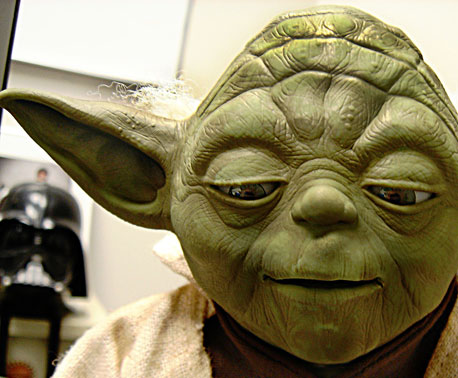
Yoda’s Top 3 Words of Wisdom


“Luke: I can’t believe it.
Yoda: That is why you fail.”

Back when I was younger and first watched the Star Wars movies my favorites were Yoda and Han Solo.

I recently watched the two latest Star Wars movies again and thought they were better than I remembered.

Again, one of the best parts was definitely Yoda.

I guess he was an early introduction to personal development and spirituality long before I had much interest in this stuff.

So today I’d like to share three of my favourite words of wisdom from that green little awesome guy.

You could do very well in any area of your life by just focusing on these few tips. Things don’t really have to be that complicated. Get these things handled reasonably well and your world opens up big time.

1. Don’t try. Do.

“Do or do not… there is no try.”

When you tell yourself and/or someone else that you will try you are in my experience more likely to give up or just stop when the first obstacle shows up.

When you say that you will do something there is more determination and power behind that decision. When the inevitable obstacles that always show up start to block your path you are determined. You will do this. So you find ways over, under, around and through the obstacles. And that’s what you have to do most of the time to actually get things done. Smooth sailing with no problems at all is pretty rare.

By making clear choices to do or not do something – and putting power behind those choices – you are more likely to actually get things done and succeed.

2. Overcome your fears.

“Fear is the path to the dark side. Fear leads to anger. Anger leads to hate. Hate leads to suffering.”

“Named must your fear be before banish it you can.”

Overcoming your fears is one of the most important things to improve yourself and grow. If you don’t you will just get stuck. But how do you do it? Well, first, as Yoda says, you have to stop avoiding your fear. You have think about it and see what is you really fear.

After you have brought some clarity to the situation, here are three of my favourite tips for actually overcoming that fear.

Face your fear.

Maybe not what you want to hear, but in my experience and from what I have learned from others this is the best way to overcome your fear.

And if you have to handle a big fear, whatever it may be, and later realise you actually survived it, many things in life you may have feared previously seems to shrink. Those fears become smaller. They might even disappear. You may think to yourself that what you thought was a fear before wasn’t that much to be afraid of at all.

Everything is relative. And every triumph, problem, fear and experience becomes bigger or smaller depending to what you compare it to.

Be curious.

This frame of mind makes it easier to face what you fear. When you are stuck in fear you are closed up. You tend to create division in your world and mind. You create barriers between you and other things/people. When you shift to being curious your perceptions and the world just opens up.

Curiosity is filled with anticipation and enthusiasm. It opens you up. And when you are open and enthusiastic then you have more fun things to think about than focusing on your fear.

How do you become more curious? One way is to remember how life has become more fun in the past thanks to your curiosity and to remember all the cool things it helped you to discover and experience.

All is one.

The ego wants to divide your world. It wants to create barriers, separation and loves to play the comparison game. The game where people are different compare to you, the game where you are better than someone and worse than someone else. All of that creates fear.

Doing the opposite removes fear. That there is no real separation between beings, that we are one and the same, might sound a bit corny.

But one thought you may want to try for a day is that everyone you meet is your friend. Another one is to see what parts of yourself you can see in someone you meet. And what parts of yourself you can see in him/her.

There is often an underlying frame of mind in interactions. Either it asks us how we are different to this person. Or how we are the same as this person. The first frame is based in how the ego likes to judge people and create separation to strengthen itself (either through feeling better or more like a victim). The second one creates warmth, an openness and curiosity within. In that one there is no place to focus on fear or judgement anymore.

This is a bit similar to the previous tip. Use both and see what works best for you.

3. Your world is a reflection of you.

“You will find only what you bring in.”

That’s what Luke is told in “The Empire Strikes Back” before he goes into the cave on Yoda’s home planet. Inside the cave Luke battles his demons – more specifically an illusion of Darth Vader – and are confronted with his owninner darkness. The darkness he brought into the cave and that could pull him over to the dark side if he allowed it to.

I think this is relevant in our world too. You find in your world what you bring into your world. And in your world you can see yourself – your thoughts and behaviours – reflected. By observing the world around you can gain insights into yourself and what you may need to improve.

Because even though there is big, big world out there with many possibilities and people in the end big change in your life comes down to you changing yourself.

It’s very easy to get stuck in thinking that your perspective, the lens through which you view reality is reality itself. But you can’t really see reality. You can only see it filtered through the lens. And the lens is you.

Changing, for example, a very negative attitude to a very positive one changes how you view yourself and your entire world. But it’s very hard to convince anyone of this. You just have to choose to try another perspective and use it for a month or so. Even though old thought patterns may want to draw you back to the comfortable stability of your old viewpoint. Which may cause you to rationalize that this positive attitude stuff is uncool or cheesy.

Truth is life will never be as in your dreams if you don’t change and correct yourself. No one is coming to save you. No book or personal development guru, not your parents, no knight/lady in white armour. Yes, people around you can of course be a big help.

But as an adult in this world it is time to grow up and save yourself. It is time to do things. To face your fears. Not just because those things are the right things to do. But also because these things are what actually work.

Image by: http://www.flickr.com/photos/metrojp/ / CC BY 2.0

If you enjoyed this article, please share it on Stumbleupon and Twitter. Thanks you very much! =)

“Don’t be fooled by the calendar. There are only as many days in the year as you make use of. One man gets only a week’s value out of a year while another man gets a full year’s value out of a week.”
Charles Richards

“A well-spent day brings happy sleep.
Leonardo Da Vinci

One thing many of us want is simply to free up time so we can do more of what we really want to do.

Here are three simple tips that have enabled me to find more time for myself to do so. And since I have a lot to do this summer I will apply them even more diligently than usual. I hope you will find these three tips helpful too to get more time out in the sun, to work on your book or blog, to play some Frisbee or just relax and take it easy.

1. Find out where your time is really going.

This is like when you are trying to lose fat. It’s very easy to fool yourself and think you are doing “pretty good” when you in actually are not doing really that good. Thinking that you are doing “pretty good” won’t get you’re the results you want though. Actually doing what is needed gives you the results you want.

An easy way to stop fooling yourself in both cases is to use a log. If you are trying to lose fat, use Fitday.com to keep and eye on how much you are really eating.

If you want to find out where your time in a normal day or week are going create a simple time log in a Word-document or something similar and simply type down notes about everything you are doing.

I have for example found that I have spent too much time on social networks like Facebook over the last few months. I will cut that stuff down to a minimum to be able to have more time to relax and rejuvenate. And to keep up with the writing on this blog and other important stuff.

2. Realise that you don’t have to do everything you do.

And that the sky might not fall if you do/don’t do something. One thing that’s stopping people from improving themselves or just finding time for themselves is all the things they ”have” to do. You don’t really have to do anything.

Try to look at it as you choosing what to do instead.

Of course, if you choose to do or not to do something there will be consequences. Sometimes big, sometimes small. Sometimes bad, sometimes good. Sometimes one thing disguised as the opposite. :)

But the point is to take control of your life and feel like you choose. Instead of having your world choosing and controlling your life. This makes it easier to find out what isn’t really that important and eliminate or reduce to free up time for more interesting things.

3. Show up and just do it.

When you have found out what you are actually doing with your time and let go of some of the things you “had to do” then show up and just do the rest.

Instead of procrastinating, instead of thinking, instead of hoping someone else will do it or take an initiative, instead of rationalizing and inventing excuses for not doing something establish the habit of just doing it.

Most of the time you need to do it anyway sometime in the future and until you are more or less forced you’ll just waste a lot of time procrastinating and thinking – and feeling bad – about having to do whatever you need to do. And if you wait for someone else to do something about it can take a lot of time before someone does so. Establishing this habit can be a bit difficult if you are used to thinking – or over thinking – a lot.

One useful way that I’ve found to develop this habit is simply to not identify so much with my thoughts and emotions and realize that I can control them instead of the other way around. I still think you should think a bit. But after that it’s most often just better to go and do whatever you want to do.

What is your best tip for freeing up more time for yourself?

How to Take Consistent Action: 7 Powerful Tips

“In essence, if we want to direct our lives, we must take control of our consistent actions. It’s not what we do once in a while that shapes our lives, but what we do consistently.”
Anthony Robbins

Maybe the biggest problem people have when trying to improve something in their lives is that they never take much action at all.

Perhaps the second biggest problem is that they don’t take consistent action over a longer time period.

Now, consistency isn’t really the sexiest or most exciting word in personal development. But it is, coupled with time, what will give you real results in your life.

Sticking with the program and doing something consistently – and not just when you feel inspired or something like that – is very, very powerful.

To me it’s also – at least at the moment – one of the most frustrating parts of personal development.

Some days go great. Some days really don’t. Quite a few days wind up somewhere in between.

I’ve been able to become more consistent in many areas and there is no thing as perfection where every day is plain awesome.

So no point in striving for some illusory perfection in any part of life. And variation and setbacks are stimulating and valuable parts of life. But still, improvements can be made.

These tips can be used to make it easier to get through the period that is needed to establish a new habit in your life (about 21-45 days or so in my experience). They can also be used after a habit is established because even then you will have bad days or slip up.

1. Use a morning ritual.

This is perhaps the most powerful tip I have found so far in this area.

You simply set up a routine in the morning that you do as soon as you wake up. This works so well because what you do early in the day often sets the context for your day.

As humans we have a strong tendency to want to be consistent with what we have done before. That’s one big reason why a bad start often leads to a bad day and a good start often leads to a good day.

Read all about my and other people’s morning rituals in this article.

2. Do things even if you don’t feel like it.

Your inner voice and feelings can be disregarded if you like. You can do whatever you want to do anyway.

3. Don’t hurt yourself.

Realize that when you disappoint yourself and don’t think and do as you really deep down want to you hurt yourself by lowering your self esteem.

Whatever you do during your day sends signals back to yourself about what kind of person you are. Do the right thing like being effective, kind or go to the gym and you feel good.

Get lazy, negative or just plain mean and you tend to feel worse after a while. You don’t get away, there is no escaping yourself. And there is always a price to pay.

This is a powerful motivator to become a better person.

4. Focus on and take responsibility for the process, not the potential results.

I use this when I workout.

I don’t take responsibility for the results in my mind. I take responsibility for showing up and doing my workout. The results – 26 pounds lost during this spring – has come anyway from that consistent action.

And this makes it easier for me to take this action when I know that is all I need to focus on. Instead of using half of the energy and focus I have available on hoping that I “reach my goal real, real soon”.

Focus on the process and you will be a lot more relaxed and prone to continue than if you stare yourself blind on the potential results that never come as quickly as you want to and puts you on an emotional roller coaster from day to day.

5. Find and do what you love or like to do.

It always easier to stick with the program if you love or at least like what you are doing every week.

So experiment and find what suits you best.

6. Let go of old self images.

A few years ago I saw myself as someone who didn’t eat healthy food or was athletic and worked out. Even when I started to do that a bit more I still kinda felt like the person I used to feel like when I was living in an unhealthy way. 

Over time I started to think more and more of myself as someone who was healthy. But I still shifted back and forth between the two self-images of being a healthy person and an unhealthy person.

So since sometime around the beginning of this year I let go of that past image of myself that felt kinda comfortable but didn’t help me.

Since then, as my self-image as a healthy person has become consistent in my mind, I find it much easier to work out and eat healthy food. It seems like the natural thing for me to do now.

7. Use reminders in your environment.

I have been posting about this concept for years now.

What you do is simply to write down what you really want to make into a habit or a natural part of your life on a post-it, on your screensaver on the computer etc.

At the moment I use a small whiteboard on my wall that has stuff like “I make $5000/month” and “Remember to have fun” written down on it.

I have found this to be very useful to keep myself on track, to keep my focus on the essential stuff and not get so distracted by everything around me.

“The highest compliment that you can pay me is to say that I work hard every day, that I never dog it.”

Wayne Gretzky needs no long introduction. He is the most well-known ice hockey player of all time and one of the absolute best that there has ever been.

But how did he make that happen? Here are three of Gretzky’s tips that may give some insight into his phenomenal success.

1. Remember to have fun.

“The only way a kid is going to practice is if it’s total fun for him… and it was for me.”

I think this is a step that many of us have a big problem with. Or just forget about. Especially as we grow older.

Because when you find something you really love to do it doesn’t seem like work that much anymore.

When you do something you love you don’t have to push yourself so much. You keep going because you like doing it, not just because your want to reach some goal (although that can be exciting too). Taking action also becomes natural when you doing something you really want to do. A lot of the time you can’t wait to get going with it.

So the problem many of us encounter may not be that we don’t know enough tips to keep ourselves motivated to keep going. The problem may be that we are working on the wrong thing all together.

So do you find out what you really want to do?

I certainly don’t have all the answers for that one, but one tip is just to explore life.

To just try things out and see what you love. It’s easy to have theories about what you or may not like. But you never know until you have tried it for a while in real life.

And even if you haven’t found that yet remember that you can have fun with a lot of things in life. A light attitude where you look for the fun in stuff instead of a grown up kind of attitude where just about everything can start to feel like dreary work makes life a whole lot more enjoyable.

I think it’s important to remember that it is OK to have fun. And that it is your responsibility to find and create that fun. No one is going to just give it to you.

2. Practise, practise, practise today.

“Procrastination is one of the most common and deadliest of diseases and its toll on success and happiness is heavy.”

Anyone who is really, really great at something has put in a huge amount of practice. More practice than most people are willing to put in. A big part of that of course comes from having fun with what you are doing.

But another – perhaps not as exciting – part is simply to have the self-discipline to not procrastinate and not bury yourself deep in a hole of boredom and inaction. Because some days are just rough or you have tough time getting started.

There are a lot of tips for overcoming procrastination on such days, here are three of my favorites:

  • Recognize that there is more pain in procrastinating than not. If you have procrastinated a lot (like me) you might have discovered that: You procrastinate to avoid doing something that is boring, hard or something like that. You want to avoid that pain.  But after having some experience with procrastination you’ll probably realise that procrastination itself causes your more pain than actually just doing what you were supposed to. Realising the true amount of pain in the two choices will make it easier to get things done.
  • Just take the first step. When you start to look too far into the future any task or project can seem close to impossible. And so you shut down because you become overwhelmed and start surfing the internet aimlessly instead. That is one of the reasons why it is good to plan for the future but then to shift your focus back to today and the present moment. Then you just focus on taking the first step today. That is all you need to focus on, nothing else. By taking the first step you change you mental state from resistant to “hey, I’m doing this, cool”. You put yourself in state where you become more positive and open, a state where you may not be enthusiastic about taking the next step after this first one but you are at least accepting it. And so you can take the next step. And the next one after that.
  • Start with the hardest task of your day. Maybe you have an important call to make that you also fear might be uncomfortable. Maybe you know you have gotten behind on answering your emails and have big pile to dig into. Maybe you have the last five pages of your paper to finish. Whatever it may be, get it out of your way the first thing you do. If you start your day this way you will feel relieved. You feel relaxed and good about yourself. And the rest of the day – and your to-do list – tends to feel a lot lighter and easier to move through. It’s amazing what difference this one action makes.

3. Take the chances you get.

“You miss 100% of the shots you don’t take.”

It’s easy to find a million excuses to not take a chance. To not take a risk. But as Gretzky points out, if you don’t take it then there is absolutely no way of succeeding. If you give it a shot there is always a chance that you might make it, even if the odds suck and you don’t even believe in it yourself. If you do that enough times then you will most likely have some success.

And succeeding is great. But just doing something and trying is great too. Because sometimes you will succeed. And the other times you can learn valuable lessons that will improve your skills and understanding and make it more likely that you will succeed the next time.

That’s what all the most successful people throughout history have done. They have failed more than most people and thereby learned more and in the end they have had a lot more success.

So the the absolute worst thing you can do is to try nothing at all.


Image by left-hand (license).

“You can have brilliant ideas, but if you can’t get them across, your ideas won’t get you anywhere”.
Lee Iacocca

“The best way to be boring is to leave nothing out.”
Voltaire

One way to make conversations a lot more awkward and unfulfilling is to bore people to half to death. Sometimes you don’t even know you are doing it (that’s at least what I have done). So today I’d like to list 7 common mistakes that I have made in conversations to help myself – and maybe someone else too – to avoid them in the future.

If you find you might make one or a few of these mistakes a bit too often don’t beat yourself up about it. That’s pointless. Just be conscious of it in your daily interactions and do the best you can to improve.

1. Babbling on.

I have found it to be helpful to be reasonably brief when, for example, telling someone a story. The long and very convoluted version seldom seems to be as appreciated as the shorter and snappier one.

Babbling on too much is, at least in my opinion, something that often comes from being too focused inward. Being too focused on yourself in a conversation.

If you instead focus more outward you’ll be less self-conscious. This reduces nervousness and slightly nonsensical babbling.

And if you focus more outward, on the people you are talking to and less on your own glorious voice and golden words you’ll be more aware of what you are saying and how the conversation is going. If you focus on the other guy/gal you’ll be more focused on getting through and you are more attentive to how your message comes across and what reactions you bring out.

2. Clinging to a topic like a drowning man.

Hanging on to a topic for too long can make a conversation boring and awkward. Often there is a natural transition from topic to topic. But if you keep coming back to the same topic over and over again or cling to it while the other(s) want to move on then you are interrupting the flow.

This can also evolve into a situation where you feel you need to be right at all costs. That’s when things tend to get really awkward. Try lightening up and letting go if you feel that is a common problem you are experiencing.

It can be interesting to listen to someone talking a lot about their passion in life. But you still have to be flexible, let the conversation flow back and forth and be mindful of the fact that not everyone will be so interested in something as you are.

A lot of the time people just want to share moments, exchange positive emotions and feel like they are connected by for example being able to relate to you in some way. I still think you talk about a hobby or passion no matter how odd it may be but it is helpful for you and the other person to avoid technical jargon, acronyms and details that only you and other enthusiasts understand.

Try to keep it simple and understandable instead. No one wants to listen to a topic that they can’t relate to in some way. Not for too long at least.

3. Being negative and whiny.

Now, it’s normal to have a bad day or just be in bad or whiny mood from time to time. But if you do it a lot or pretty much all the time, if you spend most of your time in that headspace then simply put people will probably not just be bored. They will start to avoid hanging out/talking to you.

We all have a lot going on today. And as I grow older it seems to me that people simply don’t have time or patience to listen to that negative stuff. They have more exciting things to do and more positive people that they will choose to hang out with and talk to instead.

I’d say that one of the most attractive qualities a person can have is a positive attitude and energy. It is attractive to people at your job/school, family, friends or just that cute girl/guy in the bar. And as I mentioned above, I think that one of the big things people want in any relationships is positive emotions. On a fundamental level people simply want to create a flow back and forth with people where all of you exchange positive emotions and feel good.

It is often said that enthusiasm is contagious. So is every other feeling. So not just the words you say but the mood you are in has a big effect on how people react to you and interactions and relationships develop. So be careful with your emotional states. Here is a guide to how I have improved my own attitude and maintain it at a more positive level than I used to.

4. Not listening.

Not really listening is perhaps one of the biggest mistakes people make. It has certainly been one of my biggest issues in conversations and although I think I have improved it still is.

If you are just waiting for your turn to talk instead of listening then you’ll often miss much of what is said (verbally or non-verbally). There will be a lack of genuine understanding and disconnect that makes the conversation less exciting than it could be.

Just like I mentioned in tip #1, focusing outward and on the other person and not on yourself makes it a lot easier to be a better listener.

5. Thinking it’s all about me, me, me!

So it’s pretty obvious from what you have already read so far in this article that if you focus too much on yourself then a conversation or any sort of relationship will probably become pretty boring. You will become a bad listener. You will tend to prattle on endlessly about what you like to talk about.

People are interested in themselves. That is one big reason why for example a lot of people always think everyone is thinking or talking about them and so they become shy or they don’t experience the sort of social freedom that they could.

People want to be understood and feel a connection. If you can shift your focus away from yourself, away from having your focus split between yourself and the person you are talking to then you will be a powerful and exciting exception in their week, month or life.

6. Asking a million questions.

This can become really boring pretty quickly.

A few ways to avoid this is to:

  • Make statements. Mix things up and instead of asking what someone’s favorite sports team is, just declare what yours is and see what they have to say about that. And don’t be worried about making a statement the other person may not agree with. That’s ok, they won’t get mad. Instead they probably like that you are being proactive and open and are sharing what you really think instead of putting up a front to avoid a confrontation and to get them to like you.
  • Try being quiet if there is a pause. There are sometimes pauses in conversations. You don’t have to be the one to always dive in and ask a new question to get thing rolling again. Try just being at ease with being quiet and let the other person continue instead.

7. Not being right here, right now.

This is perhaps the biggest mistake one can make. And if one can avoid it then many of the other problems above tend to reduce themselves.

Being present is not a magic pill but in a conversation it can be huge.

You are right there and you are listening just to what the other person is saying. You focus is not split. You are not thinking about what to say. Instead you let the conversation evolve naturally as you say what comes to mind. You are more relaxed, positive and open because you are not somewhere in the past or future reliving bad experiences or imagining some horrible scenario.

In this headspace people also tend to be funnier, more fun and exciting and playful in general. It’s like bringing out a better self but not having to rely on “having a good day” to do it.

My top three ways to reconnect with the present moment right now are:

  • Paraliminals. I reviewed these guided meditation cds a few months ago on the blog and they have become my favourite way to reconnect with present. I just plop down on my bed for 25 minutes or so to relax and listen. Afterwards I feel relaxed and energized and my self-talk tends to shut down or decrease significantly for maybe half a day. This makes it a lot easier to be in the present moment and just focus on what is going on right now.
  • Focus on your breathing. Take belly breaths for a minute or two and just focus on them and nothing else.
  • Focus on what’s right in front of you. Or around you. Or on you. Use your senses. Just look at what’s right in front of you right now. Listen to the sounds around you. Feel the fabric of your clothes and focus on how they feel. You can for instance use the summer sun or rain and how it feels on your skin to connect with the present.

How to Get Rid of Hiccups

Today I’d like to take a break from long articles and just focus on one practical tip you can use right now or whenever you need it.

A few years ago – well, probably 10 years ago by now – I discovered a really good way to get rid of hiccups.

It has worked every time I have used it. In the following years I have told family and friends about it and as far as I can remember it has worked as well for them as it has for me.

You need to focus

Here’s what you do. When you have the hiccups just focus your eyes and attention on something in front of you.

Maybe it’s a road sign, a painting or some other object. Focus on just that thing.

Don’t let anything or anyone else enter your field of focus. Just focus 100% of your attention on that object. Do so for a minute or two and you should have stopped hiccupping.

Why does it work?

My theory, and it’s just a theory, is that hiccups continue because the person having them focuses too much on wanting them to stop.

Just like in the case of much of the mind made suffering in our lives it is fed by you focusing on it and giving it more mental energy. If you shift your focus totally away from thinking about it and just stare at that object in front of you then you stop feeding the hiccups with mental energy.

And so they vanish.

This explanation may of course be totally wrong. :)

But the trick still puts a stop to those annoying hiccups.

What is your best tip for getting rid of the hiccups?