One very helpful life skill is to be able to chill out.
To be calm in negative situations and not overreact about all kinds of things. Or invent big, big problems in your mind – or create them in your world as you drag other people in through arguments – by making mountains out of molehills.
By being able to chill out when needed to you will:
Have a lot less stress, worry and pointless conflicts with other people.
Waste less of your time, energy and thoughts on things that aren’t really that useful.
Attract what you are. To be able to draw people who are more relaxed and positive about life into your life then you have to be that person yourself. People like to hang out with people who are similar to them (because it’s comfortable, because it brings more fun and success, because people have 24 hours in a day and so choices need to be made).
Being someone that can be cool and relaxed about things is a positive and attractive social quality for any kind of relationship.
“Confidence comes not from always being right but from not fearing to be wrong.” Peter T. Mcintyre
“When a resolute young fellow steps up to the great bully, the world, and takes him boldly by the beard, he is often surprised to find it comes off in his hand, and that it was only tied on to scare away the timid adventurers.” Ralph Waldo Emerson
One of the most common questions I get via email is how to increase your confidence in yourself.
So this week I’d simply like to share three things you can do to increase your self-confidence starting today.
“A good laugh and a long sleep are the best cures in the doctor’s book.” Irish Proverb
“The amount of sleep required by the average person is five minutes more.” Wilson Mizener
I have to say that, overall, I sleep well.
Things weren’t always like that though. I often had trouble falling asleep and would twist and turn on the bed for a long time several times a week. I sometimes slept pretty badly and if I woke up in the middle of the night then it usually took me quite some time to go back to sleep.
Over the many nights and many years I have found a handful of habits that have helped me to minimize these problems and to get a good night’s rest pretty much every time.
These are 7 habits that help me to sleep better. I hope you will share yours too in the comments.
“No matter where you go – there you are.” Confucius
“One of the greatest gifts you can give to anyone is the gift of attention.” Jim Rohn
The weekend is almost here again.
And soon, all over the world, people will make a very common mistake and get lost in a destructive habit.
They will get lost in the grey zone. They will go into a weekend that they want to spend with a good book and the family, maybe with friends down at the pub or with going out for a hike or a picnic in the sunshine.
And then they will get lost in thoughts about work.
And so the stress will start to build. The motivation and energy will start to get sucked out. The attention will wander. There is no real relaxation and recharging happening.
Today I’d like to share 90 of the smartest, most motivational and insightful procrastination quotes of all time.
Because if you’re anything like me then you been in this situation many, many times:
You know what you want to do. You certainly know what you need to be doing.
But you’re off somewhere else.
Because procrastination has once again swept into your mind and actions.
And so you escape. Onto Facebook, into a video game or a movie or simply by doing easier and less important tasks.
I have been there hundreds of times, especially during my early twenties when I was I college.
And a big part of what helped me to break out of that habit was reading about how others had tackled procrastination throughout the centuries. I hope these timeless thoughts will be as helpful for you as they have been for me.
2. You’ll have more inner stability and self-sabotage less.
When your opinion of yourself goes up then you’ll stop trying to get so much validation and attention from other people.
You become less needy and find an inner stability and strength even when your world might be negative or uncertain at times.
The increasing level of self-esteem and self worth also makes you feel more deserving of good things in life and so you’ll self-sabotage less and go after what you deep down want with more motivation and focus than ever before.
3. You’ll be happier.
The main reason why value my self-esteem so highly, why I write about this topic so often and have created a whole 12-week course around it is simply because it has made my own life so much happier and more fun.
But instead of sharing my own thoughts and experiences like I usually do I’d like to take a different approach today.
I’d like to share 101 of the most inspiring, thought provoking and uplifting thoughts from the past 2400 years on getting to know yourself, going from low self-esteem to high self-esteem and finding a self love.
Bonus: Download a free step-by-step checklist that will show you how to improve your self-esteem and keep it stable (it’s easy to save as a PDF or print out for whenever you need it during your day or week).
Inspiring Quotes on Self Love and Self-Esteem
“You yourself, as much as anybody in the entire universe, deserve your love and affection.” – Buddha
“Until you value yourself, you won’t value your time. Until you value your time, you will not do anything with it. ” – M. Scott Peck
“A man cannot be comfortable without his own approval.” – Mark Twain
“Never be bullied into silence. Never allow yourself to be made a victim. Accept no one’s definition of your life, but define yourself.” – Harvey Fierstein
“Love yourself first and everything else falls into line. You really have to love yourself to get anything done in this world.” – Lucille Ball
“Remember always that you not only have the right to be an individual, you have an obligation to be one.” – Eleanor Roosevelt
“If only you could sense how important you are to the lives of those you meet; how important you can be to people you may never even dream of. There is something of yourself that you leave at every meeting with another person.” – Fred Rogers
“Low self-esteem is like driving through life with your hand-break on.” – Maxwell Maltz
“What lies behind us and what lies before us are tiny matters compared to what lies within us.” – Ralph Waldo Emerson
“When you recover or discover something that nourishes your soul and brings joy, care enough about yourself to make room for it in your life.” – Jean Shinoda Bolen
“Self-care is never a selfish act—it is simply good stewardship of the only gift I have, the gift I was put on earth to offer to others.” – Parker Palmer
“When you adopt the viewpoint that there is nothing that exists that is not part of you, that there is no one who exists who is not part of you, that any judgment you make is self-judgment, that any criticism you level is self-criticism, you will wisely extend to yourself an unconditional love that will be the light of the world.” – Harry Palmer
“The deepest principle in human nature is the craving to be appreciated.” – William James
“To fall in love with yourself is the first secret to happiness.” – Robert Morley
“Don’t waste your energy trying to change opinions … Do your thing, and don’t care if they like it.” – Tina Fey
“So then, the relationship of self to other is the complete realization that loving yourself is impossible without loving everything defined as other than yourself.” – Alan Watts
“Owning our story and loving ourselves through that process is the bravest thing that we’ll ever do.” – Brené Brown
“One of the greatest regrets in life is being what others would want you to be, rather than being yourself.” – Shannon L. Alder
“Inaction breeds doubt and fear. Action breeds confidence and courage. If you want to conquer fear, do not sit home and think about it. Go out and get busy.” – Dale Carnegie
“Once you embrace your value, talents and strengths, it neutralizes when others think less of you.” – Rob Liano
“To accept ourselves as we are means to value our imperfections as much as our perfections.” – Sandra Bierig
“I don’t want everyone to like me; I should think less of myself if some people did.” – Henry James
“To establish true self-esteem we must concentrate on our successes and forget about the failures and the negatives in our lives.” – Denis Waitley
“A healthy self-love means we have no compulsion to justify to ourselves or others why we take vacations, why we sleep late, why we buy new shoes, why we spoil ourselves from time to time. We feel comfortable doing things which add quality and beauty to life.” – Andrew Matthews
“Our self-respect tracks our choices. Every time we act in harmony with our authentic self and our heart, we earn our respect. It is that simple. Every choice matters.” – Dan Coppersmith
“People may flatter themselves just as much by thinking that their faults are always present to other people’s minds, as if they believe that the world is always contemplating their individual charms and virtues.” – Elizabeth Gaskell
“Don’t rely on someone else for your happiness and self-worth. Only you can be responsible for that. If you can’t love and respect yourself – no one else will be able to make that happen. Accept who you are – completely; the good and the bad – and make changes as YOU see fit – not because you think someone else wants you to be different.” – Stacey Charter
“Don’t ask yourself what the world needs, ask yourself what makes you come alive. And then go and do that. Because what the world needs is people who have come alive.” – Howard Washington Thurman
”If you don’t love yourself, nobody will. Not only that, you won’t be good at loving anyone else. Loving starts with the self.” – Wayne Dyer
“The worst loneliness is to not be comfortable with yourself.” – Mark Twain
“It is not the mountain we conquer but ourselves.” – Sir Edmund Hillary
“One’s dignity may be assaulted, vandalized and cruelly mocked, but it can never be taken away unless it is surrendered.” – Michael J. Fox
“My best friend is the one who brings out the best in me.” – Henry Ford
“No other love no matter how genuine it is, can fulfill one’s heart better than unconditional self-love.” – Edmond Mbiaka
“Lighten up on yourself. No one is perfect. Gently accept your humanness.” – Deborah Day
“It’s all about falling in love with yourself and sharing that love with someone who appreciates you, rather than looking for love to compensate for a self-love deficit.” – Eartha Kitt
“Too many people overvalue what they are not and undervalue what they are.” – Malcolm S. Forbes
“Whatever course you decide upon, there is always someone to tell you that you are wrong. There are always difficulties arising which tempt you to believe that your critics are right. To map out a course of action and follow it to an end requires courage.” – Ralph Waldo Emerson
“Never bend your head. Always hold it high. Look the world straight in the face.” – Helen Keller
“You have been criticizing yourself for years, and it hasn’t worked. Try approving of yourself and see what happens.” – Louise L. Hay
“To love oneself is the beginning of a life-long romance” – Oscar Wilde
“Be faithful to that which exists within yourself.” – André Gide
“Act as if what you do makes a difference. It does.” – William James
“The most beautiful people we have known are those who have known defeat, known suffering, known struggle, known loss, and have found their way out of the depths. These persons have an appreciation, a sensitivity and an understanding of life that fills them with compassions, gentleness, and a deep loving concern. Beautiful people do not just happen.” – Elizabeth Kubler-Ross
“I prefer to be true to myself, even at the hazard of incurring the ridicule of others, rather than to be false, and to incur my own abhorrence.” – Frederick Douglass
“You have to believe in yourself when no one else does – that makes you a winner right here.” – Venus Williams
“If you do not respect your own wishes, no one else will. You will simply attract people who disrespect you as much as you do.” – Vironika Tugaleva
“I had to grow to love my body. I did not have a good self-image at first. Finally it occurred to me, I’m either going to love me or hate me. And I chose to love myself. Then everything kind of sprung from there. Things that I thought weren’t attractive became sexy. Confidence makes you sexy.” – Queen Latifah
“We are each gifted in a unique and important way. It is our privilege and our adventure to discover our own special light.” – Mary Dunbar
“If you have the ability to love, love yourself first.” – Charles Bukowski
“To be yourself in a world that is constantly trying to make you something else is the greatest accomplishment.” – Ralph Waldo Emerson
“People who love themselves, don’t hurt other people. The more we hate ourselves, the more we want others to suffer.” – Dan Pearce
“Love is the great miracle cure. Loving ourselves works miracles in our lives.” – Louise Hay
“The real difficulty is to overcome how you think about yourself.” – Maya Angelou
“It took many years of vomiting up all the filth I’d been taught about myself, and half-believed before I was able to walk on the earth as though I had a right to be here.” – James Baldwin
“A person learns how to love himself through the simple acts of loving and being loved by someone else.” – Haruki Murakami
“My mother told me to be a lady. And for her, that meant be your own person, be independent.” – Ruth Bader Ginsburg
“Find the love you seek, by first finding the love within yourself. Learn to rest in that place within you that is your true home.” – Sri Sri Ravi Shankar
“Love yourself enough to set boundaries. Your time and energy are precious. You get to choose how you use it. You teach people how to treat you by deciding what you will and won’t accept.” – Anna Taylor
“The most terrifying thing is to accept oneself completely.” – Carl Gustav Jung
“The real difficulty is to overcome how you think about yourself.” – Melanie Koulouris
“You’re always with yourself, so you might as well enjoy the company.” – Diane Von Furstenberg
“Who looks outside, dreams; who looks inside, awakes.” – Carl Gustav Jung
“The better you feel about yourself, the less you feel the need to show off.” – Robert Hand
“I think everybody’s weird. We should all celebrate our individuality and not be embarrassed or ashamed of it.” – Johnny Depp
“You are very powerful, provided you know how powerful you are.” – Yogi Bhajan
“No one can make you feel inferior without your consent.” – Eleanor Roosevelt
“It ain’t what they call you, it’s what you answer to.” – W.C. Fields
“There are days I drop words of comfort on myself like falling leaves and remember that it is enough to be taken care of by myself.” – Brian Andreas
“Trust yourself. You know more than you think you do.” – Benjamin Spock
“Because one believes in oneself, one doesn’t try to convince others. Because one is content with oneself, one doesn’t need others’ approval. Because one accepts oneself, the whole world accepts him or her.” – Lao-Tzu
“People who want the most approval get the least and the people who need approval the least get the most.” – Wayne Dyer
“There is nothing noble about being superior to some other man. The true nobility is in being superior to your previous self.” – Hindu Proverb
“I found in my research that the biggest reason people aren’t more self-compassionate is that they are afraid they’ll become self-indulgent. They believe self-criticism is what keeps them in line. Most people have gotten it wrong because our culture says being hard on yourself is the way to be.” – Kristen Neff
“If you are insecure, guess what? The rest of the world is too. Do not overestimate the competition and underestimate yourself. You are better than you think.” – T. Harv Eker
“When you stop living your life based on what others think of you real life begins. At that moment, you will finally see the door of self-acceptance opened.” – Shannon L. Alder
“You find peace not by rearranging the circumstances of your life, but by realizing who you are at the deepest level.” – Eckhart Tolle
“Growth begins when we start to accept our own weakness.” – Jean Vanier
“Nothing can stop the man with the right mental attitude from achieving his goal; nothing on earth can help the man with the wrong mental attitude.” – Thomas Jefferson
“Your task is not to seek for Love, but merely to seek and find all the barriers within yourself that you have built against it.” – Rumi
“When we fulfill our function, which is to truly love ourselves and share love with others, then true happiness sets in.” – Gabrielle Bernstein
“Accept yourself, love yourself, and keep moving forward. If you want to fly, you have to give up what weighs you down.” – Roy T. Bennett
“Did your mom ever tell you, ‘If you can’t say something nice, don’t say anything’? She was right–and talking nicely also applies when you’re talking to yourself, even inside your head.” – Victoria Moran
“You can have anything you want if you are willing to give up the belief that you can’t have it.” – Dr. Robert Anthony
“Self-love is an ocean and your heart is a vessel. Make it full, and any excess will spill over into the lives of the people you hold dear. But you must come first.” – Beau Taplin
“Beauty begins the moment you decided to be yourself.” – Coco Chanel
“Your problem is you’re… too busy holding onto your unworthiness.” – Ram Dass
“The reward for conformity is that everyone likes you but yourself.” – Rita Mae Brown
“She lacks confidence, she craves admiration insatiably. She lives on the reflections of herself in the eyes of others. She does not dare to be herself.” – Anais Nin
“People are like stained-glass windows. They sparkle and shine when the sun is out, but when the darkness sets in their true beauty is revealed only if there is light from within.” – Elisabeth Kübler-Ross
“If you aren’t good at loving yourself, you will have a difficult time loving anyone, since you’ll resent the time and energy you give another person that you aren’t even giving to yourself.” – Barbara De Angelis
“Most of the shadows of this life are caused by standing in one’s own sunshine.” – Ralph Waldo Emerson
“It’s surprising how many persons go through life without ever recognizing that their feelings toward other people are largely determined by their feelings toward themselves, and if you’re not comfortable within yourself, you can’t be comfortable with others.” – Sidney J. Harris
“When I loved myself enough, I began leaving whatever wasn’t healthy. This meant people, jobs, my own beliefs and habits – anything that kept me small. My judgement called it disloyal. Now I see it as self-loving.” – Kim McMillen
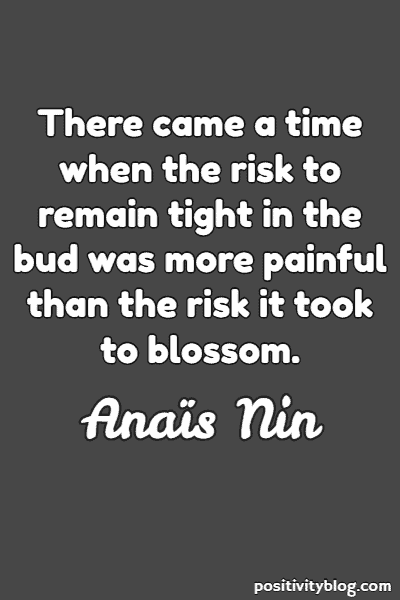
“There came a time when the risk to remain tight in the bud was more painful than the risk it took to blossom.” – Anaïs Nin
“It took me a long time not to judge myself through someone else’s eyes.” – Sally Field
“The best day of your life is the one on which you decide your life is your own. No apologies or excuses. No one to lean on, rely on, or blame. The gift is yours – it is an amazing journey – and you alone are responsible for the quality of it. This is the day your life really begins.” – Bob Moawad
“Self-pity gets you nowhere. One must have the adventurous daring to accept oneself as a bundle of possibilities and undertake the most interesting game in the world making the most of one’s best.” – Harry Emerson Fosdick
“It is never too late to be what you might have been.” – George Eliot
Here’s the next step…
Now, you may think to yourself:
“This is really helpful and inspiring. But what’s the easiest way to put this into practice and actually make a real change with my self-esteem?”.
Well, I’ve got something special for you…
A free step-by-step checklist with 12 practical steps for improving your self-esteem… save it or print it out so you have it for your daily life and for the next time when your self-esteem starts to sink.
Download it now by entering your email below.